
Halal Certificate and Mark Usage Rules
Issuer and scope of responsibility: certification decisions and certificate issuance follow Indonesia’s BPJPH rules
This determines whom you verify a certificate with, whom you raise an issue with, and where we sit in the process.
What we do
- Certification route assessment: reviewing your product category, ingredients and target market to identify the applicable route and the documents required.
- Document preparation: helping you organise formulations, process flows, supplier records and other application materials to reduce back-and-forth.
- Process follow-up and audit coaching: milestone reminders, document review and site preparation support from submission through the on-site audit.
Scope of responsibility
- Certification decisions and certificate issuance follow Indonesia’s BPJPH rules.
- We are a foreign halal certification body (LHLN) recognised by Indonesia’s BPJPH, working within the scope BPJPH authorises.
- We make no commitment regarding audit outcomes or lead time.
The issuer, certificate number, product scope and validity period are governed by the certificate document issued by BPJPH and by the information returned through its official verification channel.
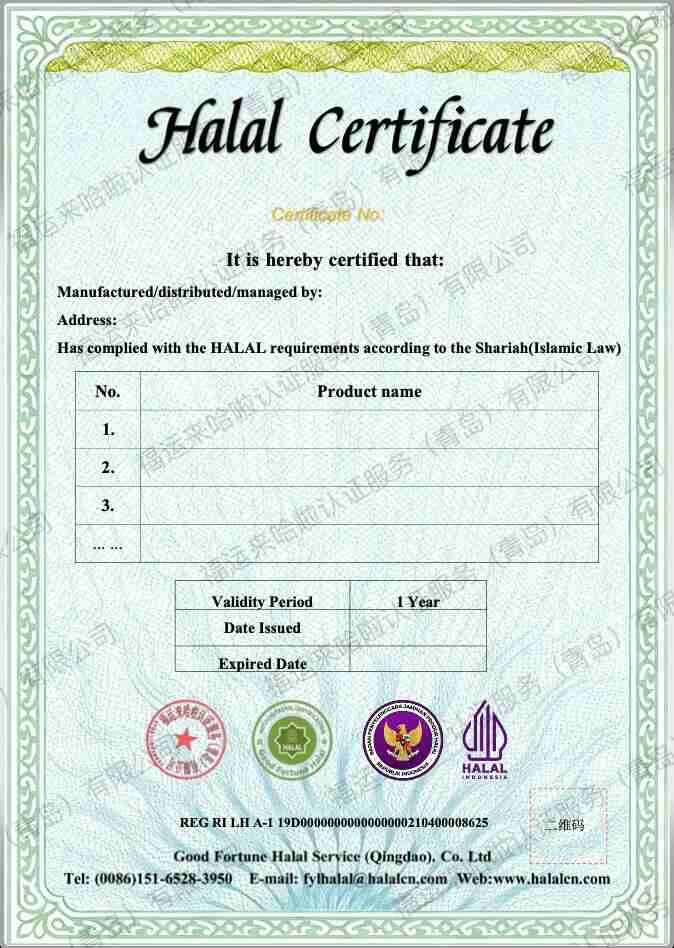
What a certificate usually contains
Once a certificate is issued, check each item against your application before ordering packaging or shipping goods to market.
Halal mark usage rules
The mark shows that a product is within the certificate scope and that the certificate is currently valid, so the scope of use must stay aligned with the certificate status.


Mark artwork is governed by the source files supplied by the certification body and must not be redrawn, rescaled or altered.
Acceptable use
- Use the source files supplied by the certification body without changing proportions, colours or elements.
- Apply the mark to retail packaging of products covered by the certificate, normally in a prominent front or back position.
- Show the certificate number wherever the mark appears in e-commerce listings and marketing materials.
- Use the mark while the certificate is valid and the product details match the certificate.
Unacceptable use
- Use beyond the product categories, items or production sites covered by the certificate.
- Rescaling, distorting or recolouring the mark, or adding text, graphics or other elements.
- Continued use after the certificate has expired, been suspended or withdrawn, or after details have changed but not yet been updated.
- Use on products, ingredients or factory promotions that are not certified, implying that they are.
Possible consequences of misuse
The effects below are commonly seen where mark usage is not compliant. They describe risk and are not a judgement about any specific case or timeline.
The mark is required to be withdrawn
Where an issuing body finds non-compliant use during supervision or sampling, it will usually require corrective action within a set period, during which the mark must not be used.
The certificate may be suspended or withdrawn
In more serious cases the issuing body may suspend or withdraw the certificate, and the verification record linked to that number becomes invalid.
Distribution can be held up
Where an importer, retailer or e-commerce platform finds the mark inconsistent with the certificate, it may request further documents, pause orders or take listings down.
More work on corrective action and renewal
Corrective action usually means extra records and re-confirming ingredients and production lines, which extends preparation for renewal or re-issuance.
Responsibility rests with the user
The certificate and mark are used by the company itself, so responsibility for inaccurate claims rests with the user.
Printed packaging may become unusable
After mark artwork or scope changes, packaging already printed to the previous requirements can usually no longer be used.
Export and packaging: four stages for applying the mark
Receiving the certificate is only the start. The mark has to travel through packaging, orders and the shipping gateway so that printed material remains usable.
Before packaging design and printing
Check that the certificate product scope matches the product name, specification and flavour on the pack. Give the source artwork to the designer and confirm proportions, colours and clear space so the printer does not adjust it independently.
Contract manufacturing and multiple sites
Where a contract manufacturer makes or repacks the product, confirm the certificate covers that production address and category. With multiple sites, product scope and mark use must correspond site by site.
Booking and shipping documents
For sea freight via Tianjin or Dalian or land transshipment via Manzhouli or Khorgos, invoice description, packing batch and certificate number must align. If mark photos and certificate details differ, the importer may ask for clarification.
After arrival and listing
Keep the certificate number, product scope and validity ready for importer or platform checks. After a certificate change, renewal or mark artwork update, replace packaging and listing materials promptly.
These are general notes on mark use and export alignment. The certificate document, issuing body requirements and actual carrier and importer arrangements prevail.
How to verify a certificate
Three steps: confirm the certificate itself first, then decide whether to use the mark.
Check the number on this site
Enter the certificate number on the certificate enquiry page and compare the holder, product scope and validity period with the certificate you hold.
Check through the issuing body
Use the verification URL or QR code on the certificate, or the official channel of the issuing body (including Indonesia’s BPJPH and its authorised bodies). The official result prevails.
Pause use if details do not match
If the verification result does not match the certificate or the mark in use, stop using the mark and confirm with the issuing body or your Indonesian importer before deciding next steps.
Related sections
Not sure whether your product needs halal certification?
Tell our consultants your product category and target market. We will first help you identify the right path and the documents required, and you can then decide whether to proceed.

